
New software can only help a business if people actually use it. When employees do not understand a tool or do not trust it, they go back to old methods. Digital adoption helps prevent this. It means helping employees learn, accept, and use new software in their daily work.
Many companies face this problem today. They launch a new system, but employees struggle to use it, keep asking for help, or avoid the tool completely. According to research, employees waste an average of 2.83 hours every week dealing with technology that does not work properly, runs slowly, or has poor design and inefficient workflows. These problems can waste valuable time and prevent businesses from getting the full value of their software.
The solution is to support people after launch, not just before it. At TuvisTech, we help businesses implement Zoho solutions, streamline workflows, and support teams through digital adoption. Let’s explore what digital adoption is and why it matters after software implementation.
Why Digital Adoption Matters After Software Implementation
Most people think the work is done once new software goes live. The system is installed, the data is moved, and everyone gets a short training session. But this is where the real test begins.
After launch, employees have to use the software every day. If it feels hard or confusing, they go back to what they know, like spreadsheets, emails, or paper notes. The company is then paying for a tool that nobody really uses.
This costs more than money. Work slows down because people use two systems instead of one. Data ends up in different places, so reports are not always correct. Employees also get frustrated, because they feel the new tool made their job harder, not easier.
Digital adoption fixes this. When people get the right help after launch, such as simple training, quick answers to their questions, and support from their managers, they feel confident using the new tool. They use it more, make fewer mistakes, and the business finally gets the results it expected.
Digital Adoption vs Digital Transformation
Many people mix up these two terms, but they are not the same. Digital adoption is about getting people to use a tool well. Digital transformation is a bigger change in how the whole business works.
| Comparison Factor | Digital Adoption | Digital Transformation |
| Meaning | Helping people use a new tool in their daily work. | Changing how the whole business works using technology. |
| Main focus | People and how they use the software | Business plans, processes, and culture |
| Size | One tool or one team | The whole company |
| Time needed | Weeks or months after a software launch | Years, and it keeps going |
| Goal | Make sure the software is used properly. | Help the business grow and stay ahead. |
| Example | Sales team uses a new CRM every day | Company moves its whole business online |
The Key Pillars of Successful Digital Adoption
Digital adoption does not happen by chance. It stands on a few strong supports, and when one is missing, people slowly go back to their old ways of working.
1. A tool that’s easy to use:
Nobody wants to fight with software all day. If a tool is slow, hard to log into, or confusing, people quietly go back to their old spreadsheets. A good tool fits the way the team already works. It doesn’t just look nice in a demo.
2. Support from leaders and managers:
Most people won’t change just because they were told to. They want to know why it’s happening and what’s in it for them. It also helps a lot when their manager uses the tool too. When the boss still asks for updates by email, employees are less likely to adopt the new system.
3. Clear steps for everyone:
If five people do the same task five different ways, the data gets messy fast. Teams need to know who does what, and when. Once the steps are clear, using the tool stops feeling like extra work and just becomes part of the day.
4. Checking progress and listening to your team:
Don’t wait a year to see if it’s working. Look at how often people use the tool, and simply ask them what’s annoying them. Small problems are easy to fix early. Left alone, they push people away. This is how technology for business growth keeps paying off long after launch day.
To understand the common reasons behind failed software deployments, explore our guide:
https://tuvistech.com/why-software-deployments-fail-without-the-right-process-automation-solutions/
What Are the Benefits of Digital Adoption?
Buying software is the easy part. The payoff comes later, once people actually use it. Here’s what a business gets when that happens.
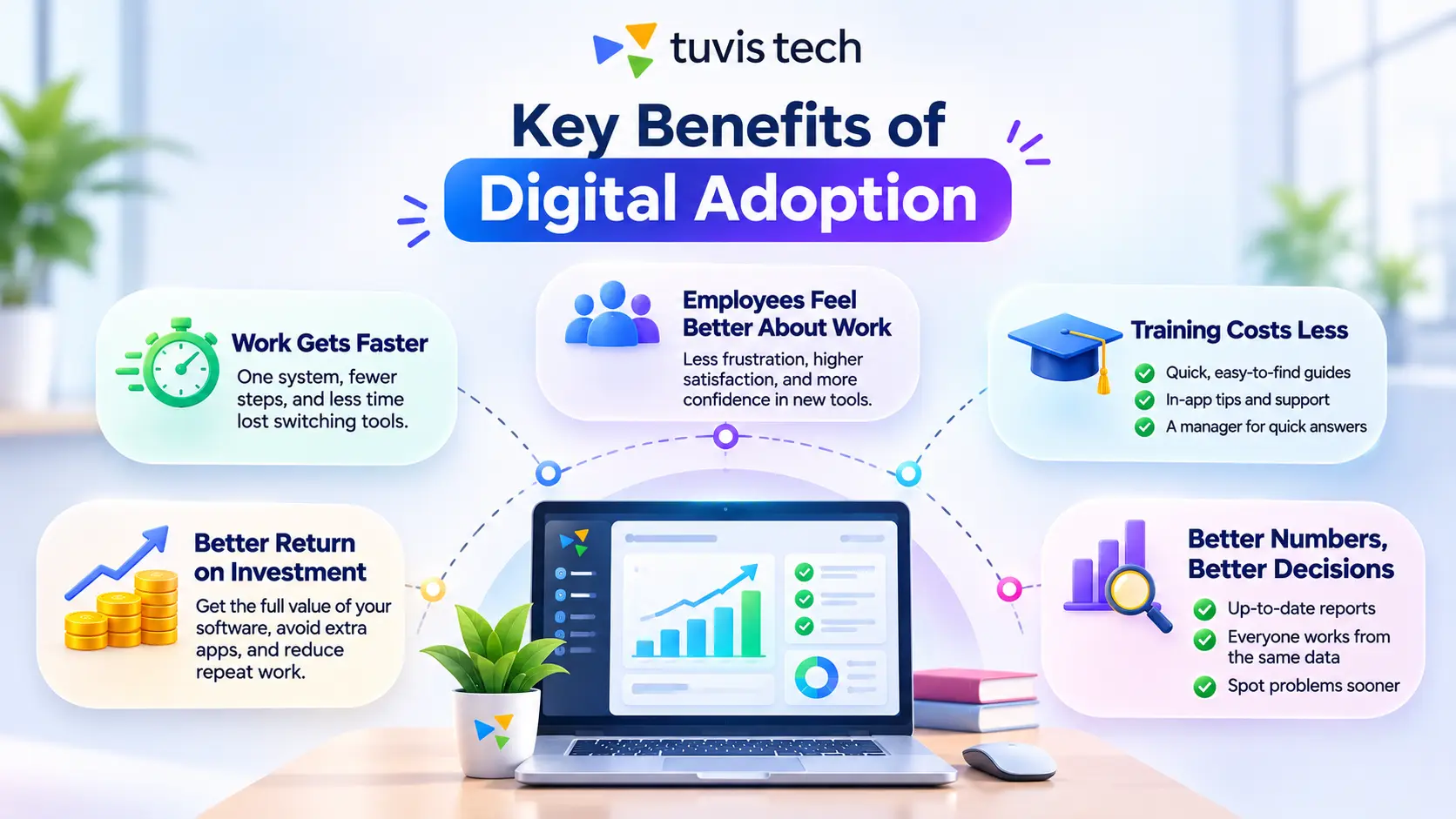
1. Better Return on Investment
Software costs a lot. If half the team ignores it, the business may not get the full value of its software investment. Good adoption fixes that. It also cuts the cost of extra apps and repeat work that pile up when people don’t trust the new system.
2. Work gets faster:
Think about how much time is lost jumping between an old spreadsheet and a new tool. Once everyone settles into one system, that goes away. Tasks take fewer steps, and fewer things slip through.
3. Training costs less:
Training works best when it’s short and about the job someone does every day. A sales rep doesn’t need to learn what the finance team does. A few things help here:
- Quick guides people can open when they’re stuck
- Tips inside the tool itself
- A manager who can answer small questions right away
4. Employees feel better about work:
Nobody likes fighting with a tool all day. When the software makes the job easier, people relax. They also stop dreading the next update, which helps a lot when new tools come along.
5. Better numbers, better decisions:
When everyone uses the same system, the data sits in one place. No more arguing over whose spreadsheet is right. A manager can open one report and trust it.
- Reports are up to date
- Teams work from the same figures
- Problems show up sooner
Common Digital Adoption Mistakes Businesses Should Avoid
Even good software can fail when a company makes small mistakes after launch. Most of these are easy to avoid if you know what to look for. Here are the ones that cause the most trouble.
1. Treating Launch Day as the Finish Line
A lot of companies wrap up the rollout, thank everyone, and go back to their other work. Then a month later, half the team is using the old system again, and nobody noticed when it started. Adoption doesn’t end at go-live. Someone has to keep checking in, answering questions, and reminding people for a few months at least.
2. Not Explaining Why the Change Is Happening
Telling people to use a new tool and not saying why rarely works. They start wondering if it’s just more work for them. Even two or three honest lines help, like what problem the tool solves and how it will save them time. It costs almost nothing and avoids a lot of grumbling later.
3. Giving Every Role the Same Training
The finance team and the sales team don’t use software the same way, so one big session for everyone wastes half the room’s time. Training sticks better when it matches the job:
- Short lessons built around tasks people do every day
- Practice with real work, not a demo account
- A quick guide they can open when they get stuck
4. Leaders Who Don’t Use the Tool Themselves
If a manager still asks for a status update by email, the team gets the message that the new system is optional. People watch what their boss does, not what the announcement said. When managers use the tool and expect the same from their team, others usually follow.
5. Not Asking Employees What Isn’t Working
A slow page or a confusing menu sounds small, but it’s enough to make someone give up and go back to a spreadsheet. If nobody asks, these problems stay hidden. A short survey or a quick chat every few weeks is usually enough to catch them. Some signs to watch for:
- People keep a side spreadsheet “just in case”
- The same questions keep reaching the help desk
- Only a few people know how to use the tool well
Digital Adoption Examples in the Workplace
1. CRM Adoption in Sales Teams
A sales team starts using a CRM to keep track of customers and deals. You can tell adoption is working when reps update it after every call, and managers use it to plan sales numbers. Nobody needs personal notes or side spreadsheets anymore, because everything is in one place.
2. ERP Adoption in Finance and Purchasing
Think of a company that moves its buying and payment process into an ERP system. Before, people sent requests by email and waited for replies. Now the request is made in the system, approved in the system, and matched with the invoice there too. When the email chains stop, you know the team has really adopted the tool.
3. Collaboration Tools Like Microsoft 365 or Google Workspace or Zoho Workplace
Many teams used to send files back and forth, and no one was sure which version was the latest. With a shared document, everyone works on the same file at the same time. It saves time and clears up a lot of confusion.
4. IT Service Desk Tools
In some offices, people ask IT for help by phone or by stopping someone in the hallway. A service desk tool changes that. Employees raise a request in one place, and the IT team can track and solve each one in order. Fewer problems get lost, and it is easy to see which issues come up the most.
5. Learning Platforms and AI Chatbots
Some companies set up an online learning platform so employees can learn new software at their own pace. Others add a chatbot to answer simple customer questions at any hour. In both cases, people get help when they need it, and the team has more time for harder work.
How to Measure Digital Adoption: Key Performance Indicators (KPIs)
Buying a tool does not mean people are using it well. To know if adoption is working, you need to check real numbers. These KPIs show who is using the software, how well they use it, and where they are stuck.
| KPI | What It Tells You |
| Usage Rate | How many licensed users actually use the tool? |
| Feature Adoption Rate | Which features people use and which ones they ignore |
| Task Completion Rate | Whether people finish their key tasks inside the tool |
| Time to Proficiency | How long a new user takes to work on their own |
| Support Ticket Volume | Whether people are struggling with the tool |
| User Satisfaction | Whether the tool makes daily work easier |
Conclusion: Making Digital Adoption Part of Everyday Work
New software only pays off when people use it every day. Strong digital adoption protects your investment, saves time, and helps your team work with more confidence long after launch.
Many businesses buy good software but struggle to get their teams to use it well. That is where TuvisTech can help. We are a Zoho Premium Partner, and our goal is to make digital adoption quick, dependable, and easy for your team to enjoy. Whether you need help with Zoho CRM, HR, finance, or project tools, we guide you through setup, training, and support, so you can see the digital transformation benefits you planned for.
Ready to get more from your Zoho tools? Do not wait until your team slips back into old habits. Visit our website today and book a free consultation.